How to Troubleshoot Common Issues Like Clumping or Cloudiness
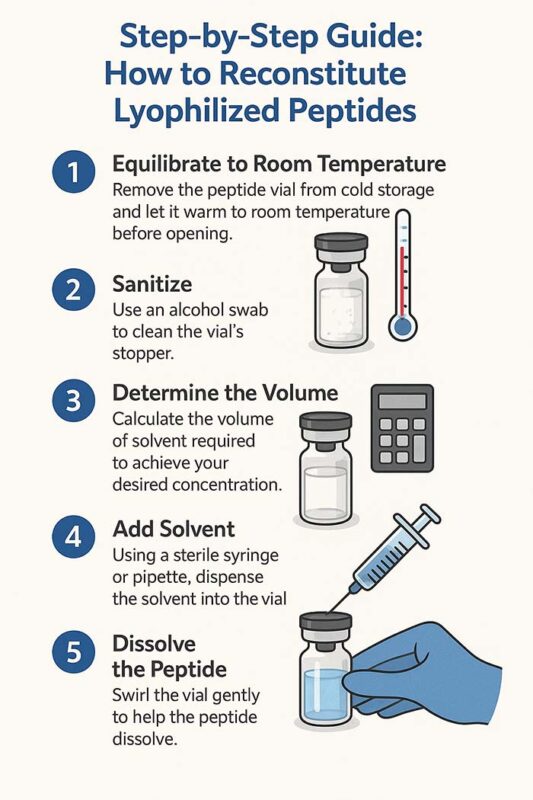
Even with the best practices, you might occasionally encounter issues when you reconstitute a peptide. Two common observations are: clumping (the peptide forms visible clumps or flakes that won’t dissolve) and cloudiness (the solution looks milky or has fine particles). Here’s how to troubleshoot these:
1. Peptide Won’t Dissolve (Clumping): If the peptide powder aggregates into clumps that stubbornly resist dissolving, consider the following steps:
-
Time and Gentle Heat: Some peptides just need more time to go into solution. After adding solvent, let the vial sit at room temperature for 15–30 minutes, occasionally gently swirling. If that doesn’t help, you can incubate the vial in a lukewarm water bath (no hotter than ~37°C unless you know the peptide is heat-stable) for several minutes. Heat can increase solubility for many peptides, but avoid high temperatures which might cause protein denaturation or chemical changes.
-
Sonication: Using a sonicator bath can often break up clumps and help dissolution. Place the sealed vial or a tube containing the solution into a ultrasonic water bath for a few minutes. The sound waves help disperse aggregates. Be cautious not to sonicate for too long or with too much power, as prolonged sonication can potentially damage some proteins. Short bursts with cooling periods are effective. Many labs sonicate difficult peptide solutions as a standard step.
-
Adjust Solvent Conditions: If clumps persist, you may need to change strategy. This is where knowing the peptide’s properties helps. For example, if you tried dissolving in PBS and got clumps, the phosphate could be precipitating with something or the salt could be causing aggregation – try pure water or a dilute acetic acid instead. If you tried water and it clumped, perhaps the peptide is hydrophobic – try a small volume of acetonitrile or DMSO next. As described earlier, you could dissolve the peptide in a minimal amount of DMSO, then slowly dilute with water. Many aggregation-prone peptides will go into solution in an organic solvent but not directly in water【4】.
-
Re-lyophilize if Necessary: As a last resort, if you added the wrong solvent initially or things went wrong, you can attempt to rescue the peptide by lyophilizing the sample again and starting over. This is only if you have the capability: you would freeze the peptide solution (even if it’s suspension) and subject it to freeze-drying to remove the solvent, returning it to a powder (ideally without the compounds that caused precipitation if volatile). Then try reconstituting the powder with a different solvent. This is an extreme measure and not always practical, but it can salvage a peptide if you suspect it hasn’t been irreversibly damaged but just improperly solubilized.
2. Solution Appears Cloudy: If the peptide dissolved but the solution isn’t clear (has a haze or tiny particles), consider these possibilities:
-
Concentration Too High: A solution can appear clear at first but become cloudy upon cooling or standing, especially if the peptide was near its solubility limit. At colder temperature, solubility decreases and some peptide might come out of solution as micro-precipitate (causing cloudiness). The fix is to either use a slightly larger volume of solvent (dilute it more) to reduce the concentration, or keep the solution at a warmer temperature if possible (though dilution is the better solution). You can also try adding a solvent that increases solubility (as above). If you must keep a high concentration, ensure the peptide stays at a temperature where it remains soluble.
-
Incompatible Buffer Components: Sometimes buffers can cause slight cloudiness due to components interacting with the peptide. For example, a peptide with a lot of hydrophobic residues might associate in a phosphate buffer and form a faint opalescence. Or if the peptide has sites that bind metal and your buffer has metal contaminants, you could see precipitation. Using ultra-pure water or a simpler solvent can resolve this. Also, verify the pH of your solution – if the pH drastically changed when you added the peptide (some peptides can shift pH if they are polyionic), the new pH might cause some component to fall out. Adjust the pH to the intended range if needed.
-
Microbial Contamination: If a previously clear peptide solution turned cloudy after several days, it could be bacterial growth. This is more likely if you did not use bacteriostatic water or if the handling introduced microbes. Bacterial contamination often also causes a distinct odor or a film. If you suspect this, do not use the solution – discard it immediately. To avoid this, always sterile-filter or use bacteriostatic water for any solution you plan to keep for more than a day or two, and store it cold.
-
Filtering the Solution: If you have cloudiness that you know is not microbial (for instance, right after reconstitution), you can pass the solution through a 0.2 μm sterile syringe filter into a new sterile vial. This will remove particulate matter and yield a clear solution. Remember to pre-rinse the filter with a bit of solvent to minimize peptide sticking to the filter membrane, and use low-protein-binding filters if available. Filtering is a quick fix for clarity, but be mindful that you might lose a small amount of peptide on the filter.
-
Extended Mixing: Some proteins (and peptides, to a lesser extent) just take a long time to fully dissolve and can look cloudy until they do. R&D Systems recommends, if flakes persist, to mix the solution for a couple of hours at room temp and then at 4°C overnight【1】. For a small research peptide, this long process is usually not needed, but for larger lyophilized proteins or very stubborn peptides, giving that extra time can yield a clear solution by the next day.
In troubleshooting, a product datasheet or technical support from the manufacturer can be invaluable. They may have specific advice if a peptide is known to be tricky (for example, “do not vortex”, or “add DTT to prevent oxidation”, etc.).
The key is to methodically change one condition at a time—solvent type, volume, temperature, time—and observe if the issue resolves. By following the guidance above, you can usually turn a problematic reconstitution into a successful one. And once you’ve found the solution (pun intended) for your peptide, make note of it for the future. Even challenging lyophilized proteins and peptides can almost always be tamed with the right approach, yielding a clear, usable solution.